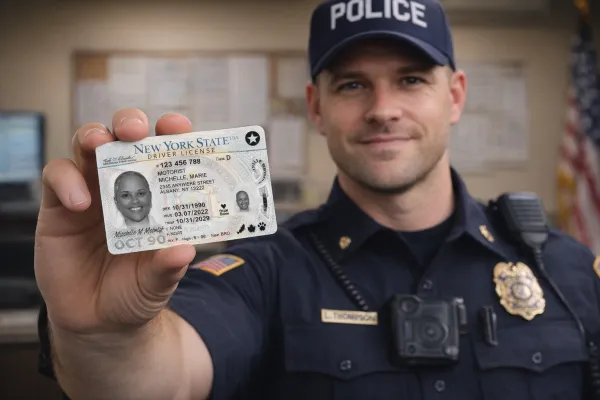
2026 New York Driver’s License Security Upgrades: How New Identity Systems Are Stopping Fake IDs
Introduction: Why Fake IDs Became a Major Issue in New York
Identity fraud has become one of the fastest-growing categories of crime in the United States. Over the past decade, the proliferation of high-quality printers, advanced design software, and global manufacturing networks has made it easier for criminals to attempt to replicate identification documents.
New York, as one of the most populous and internationally connected states in America, has faced increasing pressure to strengthen its identity verification systems. Fake driver’s licenses have been used in a wide variety of illegal activities including underage alcohol purchases, identity theft, and financial fraud.
Because driver’s licenses are widely accepted as primary proof of identity, weaknesses in the identification system can have consequences across many sectors including transportation, banking, and retail.
Between 2025 and 2026, New York State introduced significant upgrades to its driver’s license system to strengthen identity security and prevent the circulation of fake IDs.
---
The Evolution of Driver’s License Security in New York
Driver’s licenses have evolved dramatically over the past several decades. Earlier identification cards were relatively simple laminated plastic documents that could be reproduced with standard printing equipment.
As identity fraud became more common, states began introducing increasingly advanced security technologies such as holographic overlays, magnetic stripes, ultraviolet printing, and microtext patterns.
However, counterfeit technology continued to improve, forcing governments to redesign identification systems regularly.
New York began implementing modern credential security systems that incorporate advanced materials and laser engraving technologies to ensure that identity cards cannot easily be replicated.
---

The REAL ID Act and Its Impact on New York
The REAL ID Act established federal security standards for identification documents used to board domestic flights and enter certain federal facilities.
Beginning May 7, 2025, travelers must present a REAL ID-compliant credential or another federally approved identification document in order to board domestic flights within the United States.
To comply with these federal regulations, New York introduced multiple identification categories including the Standard License, REAL ID License, and Enhanced Driver License.
These credentials require stricter documentation during the application process, including proof of identity, Social Security number verification, and proof of residency.
The verification process significantly reduces the possibility of fraudulent identity creation.
---
Major Security Features in the New York Driver’s License Redesign
Modern New York driver’s licenses incorporate a wide range of anti-counterfeiting technologies designed to protect against document fraud.
One of the most important improvements is the use of polycarbonate card construction. Polycarbonate materials allow multiple layers of plastic to be fused together, making it extremely difficult to tamper with or alter the card.
Laser engraving technology is also used to permanently embed cardholder information within the plastic layers of the card.
Additional security elements include multiple laser images, transparent windows, ultraviolet security patterns, and microprinted text.
These security features make it significantly more difficult for counterfeit identification to replicate the appearance and functionality of genuine credentials.
---
Mobile Driver’s Licenses and Digital Identity
One of the most significant developments in identity verification is the introduction of mobile driver’s licenses.
Mobile IDs allow individuals to store digital versions of their identification credentials securely on their smartphones.
These systems often incorporate biometric authentication such as facial recognition or fingerprint scanning to confirm the identity of the user.
Digital credentials can generate dynamic QR codes or encrypted verification tokens, making them extremely difficult to duplicate.
As mobile identification systems become more widely adopted, they may reduce reliance on physical identification cards altogether.
---
Law Enforcement Operations Targeting Fake IDs
Technology upgrades alone cannot eliminate fake identification. Law enforcement agencies also conduct targeted enforcement operations to detect fraudulent identification documents.
New York authorities frequently perform identification checks at bars, concert venues, sporting events, and other locations where fake IDs are commonly used.
During these operations, officers may use handheld scanning devices to verify driver’s license barcodes and security features.
These enforcement initiatives help discourage the use of fake IDs and increase public awareness of the legal consequences associated with identity fraud.
---
Legal Consequences for Possessing Fake IDs in New York
New York law imposes serious penalties for individuals who possess or use fake identification documents.
Depending on the circumstances, a person may be charged with criminal possession of a forged instrument, which may be classified as a misdemeanor or felony.
Penalties can include fines, probation, and potential jail sentences.
Using a fake ID to purchase alcohol while under the legal drinking age can also result in additional penalties including mandatory alcohol education programs.
If a fake identification document is used to commit financial fraud or impersonate another individual, the charges may become significantly more severe.
---
The Future of Identity Verification in New York
The future of identification systems will likely involve a combination of digital credentials, biometric verification technologies, and artificial intelligence-based fraud detection systems.
Government agencies and private businesses are increasingly adopting advanced identity verification tools to prevent identity fraud and improve public safety.
These technologies may eventually make traditional counterfeit identification nearly impossible to use successfully.
As identity security continues to evolve, New York’s driver’s license program will likely remain at the forefront of secure credential design and digital identity innovation.
The transition toward modern identity systems reflects a broader shift toward safer and more reliable methods of verifying personal identity in an increasingly digital world.