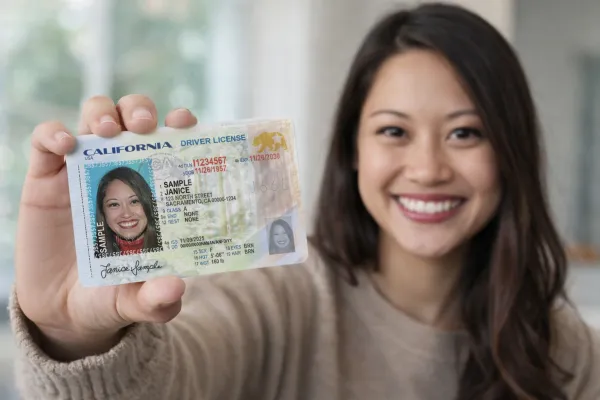

2026 California Identity Security Upgrade: Full Technical & Policy Breakdown
How California Is Strengthening Driver License & Digital ID Security in 2026
Introduction: Why 2026 Is a Turning Point for Identity Security in California
In 2026, identity verification in the United States enters a new phase. With the nationwide enforcement of federal Real ID requirements and rapid advances in digital credential systems, states are modernizing how identity documents are issued, verified, and protected.
As the most populous state in the country, California is leading one of the most comprehensive identity security upgrades in the nation. The 2026 California driver license redesign is not just a cosmetic update — it represents a structural transformation that integrates:
- Advanced polycarbonate card construction
- Laser-engraved personalization
- Enhanced optical security features
- Upgraded PDF417 barcode encryption
- Mobile Driver License (mDL) expansion
- Federal Real ID compliance alignment
This guide provides a full technical and policy analysis of the California Identity Security Upgrade 2026, optimized for clarity, search visibility, and authoritative reference.
Physical Driver License Redesign (2026 Issuance)
100% Polycarbonate Card Construction
Beginning with licenses issued or renewed after late 2025 into 2026, California transitioned to a full polycarbonate (PC) layered card structure.
Key Security Advantages
- Multi-layer fused construction
- Laser engraving embedded within card layers
- No peelable surface laminate
- High resistance to heat and mechanical tampering
Unlike traditional PVC cards, polycarbonate credentials permanently fuse layers together, making alteration attempts visibly destructive.
Laser Engraved Personalization & Secondary Portrait (CLI)
The 2026 card includes:
- Primary laser-engraved portrait
- Secondary ghost image (Changeable Laser Image / CLI effect)
- Tactile laser elements detectable by touch
Laser engraving removes material rather than adding ink, increasing durability and tamper resistance.
Advanced Holographic Overlay System
California’s updated hologram system includes:
- Multi-plane optical depth
- State seal kinetic movement
- Color-shift security elements
- Embedded microtext patterns
These features are visible under standard lighting and are engineered to be extremely difficult to reproduce accurately.
Ultraviolet (UV) Reactive Features
Under UV (blacklight) conditions, the 2026 California license reveals:
- Invisible state graphics
- UV-embedded issuance markers
- Pattern-specific reactive lines
- Hidden serial validation codes
UV consistency plays a critical role in commercial and law enforcement ID screening environments.
Enhanced PDF417 Barcode Security
Every California driver license continues to include a PDF417 2D barcode on the reverse side.
What Changed in 2026?
- Improved data formatting validation
- Structural encoding consistency checks
- Database cross-reference capabilities
- Enhanced scanner compatibility standards
The barcode encodes standardized DMV data fields and allows authorized systems to verify information accuracy.
California Mobile Driver License (mDL) Expansion
California continues expanding its Mobile Driver License (mDL) pilot program through the California Department of Motor Vehicles (DMV).
Digital credentials are accessible via:
- Apple Wallet
- Google Wallet
mDL Security Architecture
The digital system includes:
- Encrypted NFC transmission
- Selective data disclosure
- QR-based verification
- Device-level biometric authentication
Importantly, mDL supplements — but does not replace — the physical driver license.
TSA & Federal Identity Integration
The Transportation Security Administration (TSA) has expanded digital ID acceptance in participating airports.
Typical Verification Flow
- Secure data transmission
- Real-time credential validation
- Facial identity confirmation
- Federal compliance check
This multi-factor process significantly reduces identity fraud risks at aviation checkpoints.
Real ID Enforcement Alignment
The federal Real ID program, overseen by the Department of Homeland Security (DHS), reaches full enforcement phase nationwide.
Key Implications for 2026
- Real ID required for domestic flights
- Federal facility access restrictions apply
- Identity document verification standards elevated
California’s 2026 redesign aligns fully with federal security benchmarks.
Retail & Age Verification Ecosystem
Retail age verification continues evolving through:
- Barcode scanning systems
- Structured data verification
- Identity field validation logic
- Fraud detection software integration
Commercial scanners increasingly verify not only age eligibility but also document format consistency.
Data Sharing & Interoperability Trends
In 2026, identity security extends beyond the card itself. Emerging trends include:
- Inter-state DMV data cooperation
- Structured digital validation frameworks
- Standardized scanner certification protocols
- Improved issuance auditing systems
California’s scale makes it a benchmark model for future national ID modernization.
Education & Prevention Initiatives
Beyond technology, public awareness campaigns focus on:
- Responsible ID usage education
- School outreach programs
- Retail compliance training
- Community engagement
Prevention remains a core pillar of identity security strategy.
Looking Ahead: 2027–2030 Identity Security Forecast
Experts anticipate further integration of:
- Cryptographic card-embedded signatures
- Biometric binding layers
- Cloud-validated ID ecosystems
- Expanded digital wallet interoperability
California is expected to remain a leader in hybrid physical-digital identity infrastructure.
Conclusion: A Structural Shift in Identity Verification
The 2026 California Identity Security Upgrade represents more than a design refresh. It reflects a system-wide shift toward:
- Durable polycarbonate construction
- Laser-engraved security personalization
- Multi-layer optical authentication
- Strengthened barcode integrity
- Digital identity integration
- Federal compliance harmonization
Identity verification in California is transitioning from visual inspection to data-driven, multi-factor authentication.
As identity threats evolve, the state’s approach combines material science, encryption technology, database validation, and regulatory alignment — setting a new standard for secure credential issuance in the United States.